For years, wellness has often been presented as something that requires a significant investment of time.
A long morning meditation.
A complete exercise session.
An elaborate evening routine.
A digital detox.
A weekend retreat.
A perfectly planned morning beginning before sunrise.
There is nothing wrong with any of these things if they genuinely work for you.
But what if your life doesn’t allow them?
What if you have children to get ready, meetings to attend, deadlines to meet, a commute, household responsibilities and a long list of things competing for your attention?
This is where one of the emerging wellness conversations of 2026 becomes particularly interesting:
The idea is simple: instead of waiting for a large block of free time to recover from stress, you introduce small moments of recovery throughout the day.
The trend has recently been gaining attention as an alternative to highly structured wellness routines, with experts highlighting short pauses, breathing, walking and time away from screens as accessible ways to create moments of calm.
And perhaps the most appealing part?
You don’t need an hour.
Sometimes, you need two minutes.
What exactly is micro-recovery?
Micro-recovery means deliberately creating brief opportunities for your body and mind to step out of constant activity.
Think of it as a reset button.
You might take a few slow breaths before opening your next email.
Step outside for five minutes after a meeting.
Walk around the building.
Look away from your screen.
Sit quietly in your car before going inside.
Drink your coffee without simultaneously scrolling through your phone.
These moments may seem insignificant.
But that’s precisely the point.
They are small enough to fit into ordinary life.
Why are people interested in it now?
Part of the appeal comes from wellness fatigue.
Many people have become tired of feeling that wellbeing is another performance.
You need the perfect routine.
The perfect supplements.
The perfect workout.
The perfect sleep tracker score.
The perfect diet.
And if you can’t fit all of that into your life, it can feel as though you’re somehow doing wellness incorrectly.
Micro-recovery takes the opposite approach.
It says:
You don’t need to overhaul your life to create a little more breathing space.
This reflects a wider shift towards more realistic and sustainable approaches to wellbeing.
Your brain doesn’t need another task
There’s an important distinction between recovery and simply switching from one task to another.
Imagine finishing a work meeting and immediately checking your phone.
Then responding to messages while eating lunch.
Then scrolling social media during a short break.
Then answering emails while waiting for the kettle.
Technically, you’re taking breaks.
But your attention never really gets a chance to settle.
Micro-recovery introduces intentional pauses.
For a short period, you’re not trying to consume information, solve problems or respond to someone.
You’re simply allowing yourself to stop.
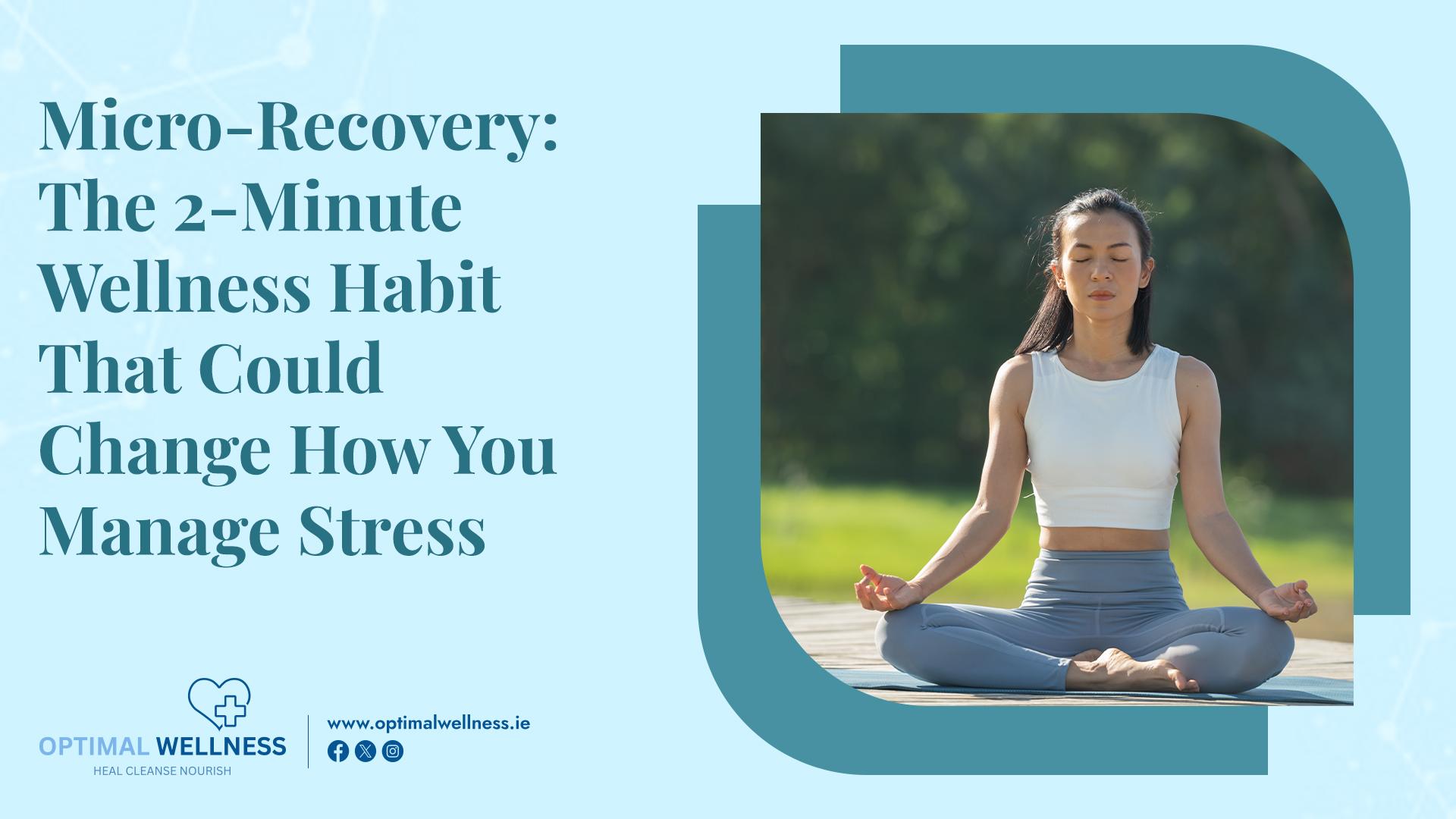
Try the two-minute reset
Here’s a simple experiment.
At some point today, stop what you’re doing for two minutes.
Put your phone down.
Unclench your jaw.
Drop your shoulders.
Take a few slow breaths.
Look around the room.
Notice how your feet feel against the floor.
Then continue with your day.
That’s it.
No app.
No equipment.
No special clothing.
No complicated technique.
The purpose isn’t to achieve a particular mental state.
It’s simply to interrupt continuous activity.
Go outside
One of the easiest forms of micro-recovery is stepping outdoors.
You don’t need to go for a long walk.
Even a few minutes outside can provide a change in environment.
You might walk around the block.
Stand in the garden.
Sit on a bench.
Get some fresh air between meetings.
Recent wellness coverage has specifically highlighted the potential value of short “green breaks”, combining brief recovery periods with exposure to nature.
The beauty of this approach is that it doesn’t require you to turn outdoor time into another fitness target.
You don’t need to hit 10,000 steps.
Just change your surroundings.
Use transitions as recovery opportunities
One of the easiest ways to introduce micro-recovery is to attach it to something you already do.
For example:
After a meeting: Take 60 seconds before opening your next task.
Before lunch: Take three slow breaths.
After driving: Sit for a moment before getting out of the car.
After work: Walk around the block before going home.
Before bed: Put your phone down and spend two minutes doing nothing.
These are called transition points.
Instead of rushing directly from one activity into another, create a small gap.
That gap is your recovery.
What about breathing exercises?
Breathing can be another useful tool.
You don’t need to master an elaborate technique.
Try simply slowing your breathing and allowing your exhalation to become comfortable and unforced.
The goal isn’t to “hack” your nervous system.
It’s to give yourself a moment of physical stillness and attention.
If breath-focused exercises make you uncomfortable or light-headed, stop and return to normal breathing.
Wellness tools should feel supportive, not stressful.
Micro-recovery isn’t the same as avoiding problems
It’s important to be realistic.
Two minutes of breathing won’t solve chronic stress.
A short walk won’t fix an unhealthy workplace.
Five minutes outside won’t replace adequate sleep.
Micro-recovery should complement broader health habits, not replace them.
If you’re consistently exhausted, overwhelmed, anxious or struggling to cope, the answer may involve more significant changes and potentially professional support.
Think of micro-recovery as one tool in a much bigger wellbeing toolkit.
Don’t turn recovery into another productivity hack
There’s an interesting trap here.
As soon as a wellness habit becomes popular, we can start trying to optimise it.
How many breaks should I take?
How long should each one be?
What’s the ideal breathing pattern?
What’s the best time of day?
Should I track them?
Do I need an app?
Suddenly, recovery becomes another performance metric.
Try not to do that.
You don’t have to track every pause.
You don’t need a streak.
You don’t need to achieve 100% compliance.
If stepping outside makes you feel better, keep doing it.
If two minutes of quiet helps you reset, use it.
If walking is more enjoyable than meditation, walk.
Wellness doesn’t need to become a spreadsheet.
Create your own micro-recovery menu
Instead of creating a strict routine, make a list of things you can do depending on the situation.
If you have 30 seconds:
Take a slow breath.
Drop your shoulders.
Look away from your screen.
If you have two minutes:
Stand up.
Stretch gently.
Drink some water.
Step outside.
If you have five minutes:
Walk around the block.
Sit somewhere quiet.
Make a cup of tea and drink it without your phone.
If you have 10–15 minutes:
Take a proper walk.
Spend time outdoors.
Listen to music.
Do some gentle movement.
The idea is flexibility.
Make your workplace part of the solution
Micro-recovery can be particularly useful during the working day.
Instead of sitting at your desk continuously for hours, build small movement breaks into your schedule.
After a video call, stand up.
Walk while taking a phone call where appropriate.
Take lunch away from your screen.
Use a few minutes between meetings to step outside rather than immediately opening another email.
If you work in an office, encourage colleagues to take genuine breaks too.
A culture where everyone feels pressured to remain constantly available isn’t particularly supportive of wellbeing.
Don’t underestimate doing nothing
One of the most underrated recovery activities may be doing absolutely nothing.
No podcast.
No Instagram.
No email.
No television.
No productivity.
Just sitting.
In a world where every spare minute can be filled with content, allowing your attention to rest can feel strangely uncomfortable.
Start small.
Two minutes.
Then five.
You might discover that boredom isn’t necessarily something that needs fixing.
Sometimes it’s simply a sign that your brain has finally stopped receiving instructions.
August is the perfect month to experiment
August can be an ideal time to try micro-recovery.
Summer naturally creates opportunities for outdoor breaks, slower moments and changes of scenery.
But the real test is whether these habits survive into September.
That’s where micro-recovery becomes useful.
It doesn’t depend on having a free afternoon.
It doesn’t require a holiday.
It doesn’t require perfect circumstances.
You can use it on a busy Tuesday.
In a crowded office.
During the school run.
Between appointments.
Before dinner.
After work.
Before bed.
The bigger picture
Perhaps the most valuable idea behind micro-recovery isn’t the two-minute break itself.
It’s the mindset.
Your wellbeing isn’t something you have to earn after you’ve finished everything else.
You don’t need to wait until you’re exhausted before taking care of yourself.
Recovery can happen throughout the day.
A breath.
A walk.
A pause.
A glass of water.
A moment outside.
A conversation.
A quiet cup of tea.
None of these things will magically eliminate life’s stresses.
But they can create small spaces within them.
And sometimes those spaces matter.
At Optimal Wellness, we believe good health should be sustainable and realistic. You don’t have to build your entire life around wellness. Instead, look for small ways to support your body and mind within the life you’re already living.
So today, try something very simple. Put down your phone. Step away from your screen. Take two minutes. And do nothing. You might be surprised by how valuable those two minutes feel.
This article is intended for general wellbeing and educational purposes and is not a substitute for individual medical or mental-health advice. If stress is persistent, significantly affecting your daily life or causing distress, consider speaking with an appropriately qualified healthcare professional.